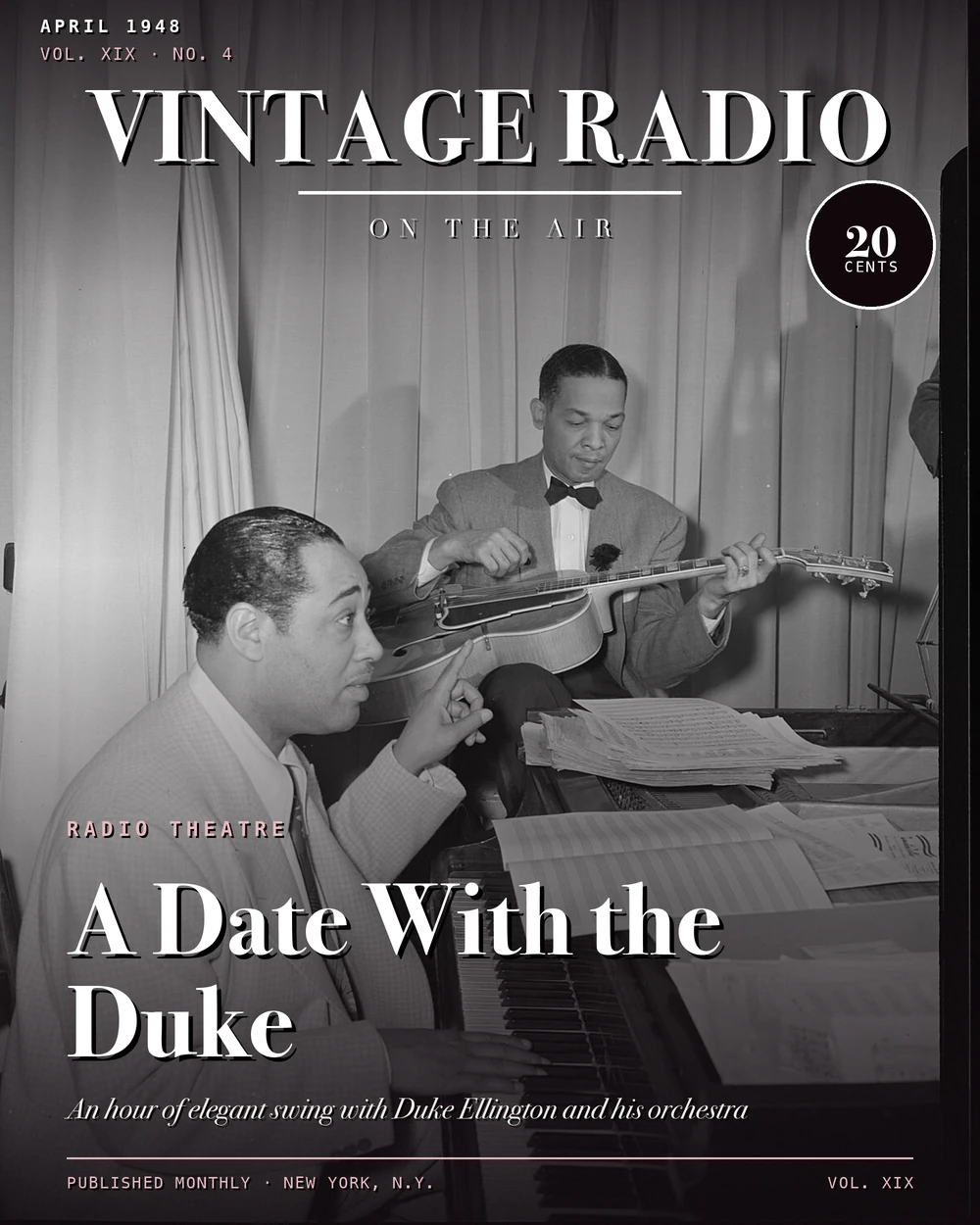
A Date With the Duke
A War Bond Drive That Became Something More
In the spring of 1945, Duke Ellington signed an agreement with the newly formed American Broadcasting Company to host a series of hour-long Saturday afternoon broadcasts on ABC's Blue Network. The official title was Your Saturday Date With the Duke, and the series ran from late April through November of that year. What made the arrangement unusual was its sponsor: the U.S. Treasury Department, which funded the broadcasts as part of the Seventh War Loan Drive. Ellington himself read on-air pitches encouraging listeners to buy war bonds, alongside MCs who shared the same duty. The music, in other words, came wrapped in a wartime civic mission — and somehow the two things fit together without one swallowing the other.
The broadcasts originated mostly from the 400 Restaurant on Fifth Avenue and 43rd Street in New York City, with some sessions coming out of Radio City Studio 6-B. Programs ran an hour on Saturday afternoons at 4 p.m., and the Armed Forces Radio Service later edited them into half-hour transcriptions for distribution to military audiences abroad.
The Orchestra and Its Vocalists
The band Ellington brought to these broadcasts was, by most accounts, among the strongest versions of the orchestra he ever assembled. Coming off the celebrated Blanton-Webster years of 1940 to 1942, the 1945 lineup included Johnny Hodges on alto saxophone, Ray Nance on trumpet and violin, and Lawrence Brown on trombone — musicians who had been shaping the Ellington sound for years.
The vocal roster was equally substantial. Joya Sherrill, who had written the lyrics to Ellington's "Take the A Train," was a principal vocalist during this period and had placed fifth in Down Beat magazine's 1945 reader's poll for female band singer. Kay Davis and Marie Ellington also appeared as vocalists, alongside Ray Nance. Al Hibbler, a blind baritone who had joined the band in December 1943, served as the featured male voice and had helped popularize "Do Nothin' Til You Hear From Me" and "I'm Just A Lucky So And So." Billy Strayhorn, Ellington's longtime composer-arranger collaborator, contributed material to the broadcasts' repertoire alongside Ellington originals and popular standards of the day.
What the Broadcasts Contained
The programs blended orchestral arrangements with popular songs, classic Ellington pieces, new arrangements written specifically for the shows, and improvisational segments that gave individual musicians room to play. Opening tunes across the eight catalogued episodes ranged from Ellington standards like "Take the A Train" and "Carnegie Blues" to newer material — "Bluetopia," "Midriff," "Blue Is the Night," "Teardrops in the Rain," "Walking With My Honey," "Can't You Read Between Those Lines" — without settling into a fixed formula.
As jazz scholar Eddie Lambert has noted, the recordings of the complete Treasury broadcasts "make up the largest single block of material in the Ellington discography." Collector Jerry Valburn spent decades tracking down original recordings and eventually released them across 24 double-LP sets in the 1980s. The Storyville label began reissuing the material as 2-CD sets in 2000.
A Short Run at a Turning Point
The series ran from April 27 to November 17, 1945, with a return run from April through August 1946. Eight episodes are catalogued in this collection. Ellington was no stranger to radio by this point — he had been a regular on CBS from 1927 through 1932 — and the composer of more than 900 tunes, including "Satin Doll," "Sophisticated Lady," "Caravan," and "Mood Indigo," needed no particular occasion to fill an hour of airtime.
But the timing of the series placed it at a moment when the big band format was starting to lose ground to solo vocalists like Frank Sinatra and Bing Crosby. The Treasury sponsorship gave the broadcasts a defined purpose and an ending point tied to the war's conclusion. Whether that sponsorship prolonged the series or simply gave it a frame it wouldn't otherwise have had, the recordings that survive document an orchestra operating at full strength during a window that wouldn't last much longer.